The 826K "name" is the only skip — followers lie, profit doesn't.
Ranked by followers, every name looks worth it.
The 826K-follower star loses you $3,560 — the 54K nobody is pure profit. Followers lie.
The anomaly
Every channel earns a measurement layer. It becomes the giant.
In every channel, the company that owns the money question — what will this return, what should I pay, did it work — becomes the giant. Creator marketing has directories to find creators and CRMs to run campaigns. Nobody owns the money question. That empty seat is the company.
Who tells you if it paid off?
Search→Google Analytics
Email→Klaviyo
Paid ads→Triple Whale
Creators · $33B/yr→? no one yet
Each one became a huge company — Klaviyo, the one for email, is now public at ~$9B. Creators is a bigger channel with nobody in the seat. (Modash, GRIN & ShopMy do search & workflow — not the money question.)
flows to creators today — on track for ~$100B by 2030, still allocated almost entirely on guesswork.
2020$9.7B
2021$13.8B
2022$16.4B
2023$21.1B
2024$24B
2025$33B
2026~$40B
2027~$50B
2028~$63B
2029~$79B
~3× by 2030
2030~$100B
Actual (2020–25)Projected (2026–30, dashed)
60%
of brands say ROI measurement is their #1 challenge
0
platforms can forecast a deal's profit before signing — Modash, GRIN, HypeAuditor included
$5K/mo
the typical agency retainer — and the decision still ends in that spreadsheet
Statista / Mordor / IMH — creator-marketing spend, 2020–25 actuals ($9.7B→$33B) and 2026–30 projection (~25–30% CAGR to ~$80–115B) · Sprout Social / eMarketer benchmark surveys.
The wedge
We answer the one question they can't get anywhere: will this creator make me money?
app.acurrate.com/discover
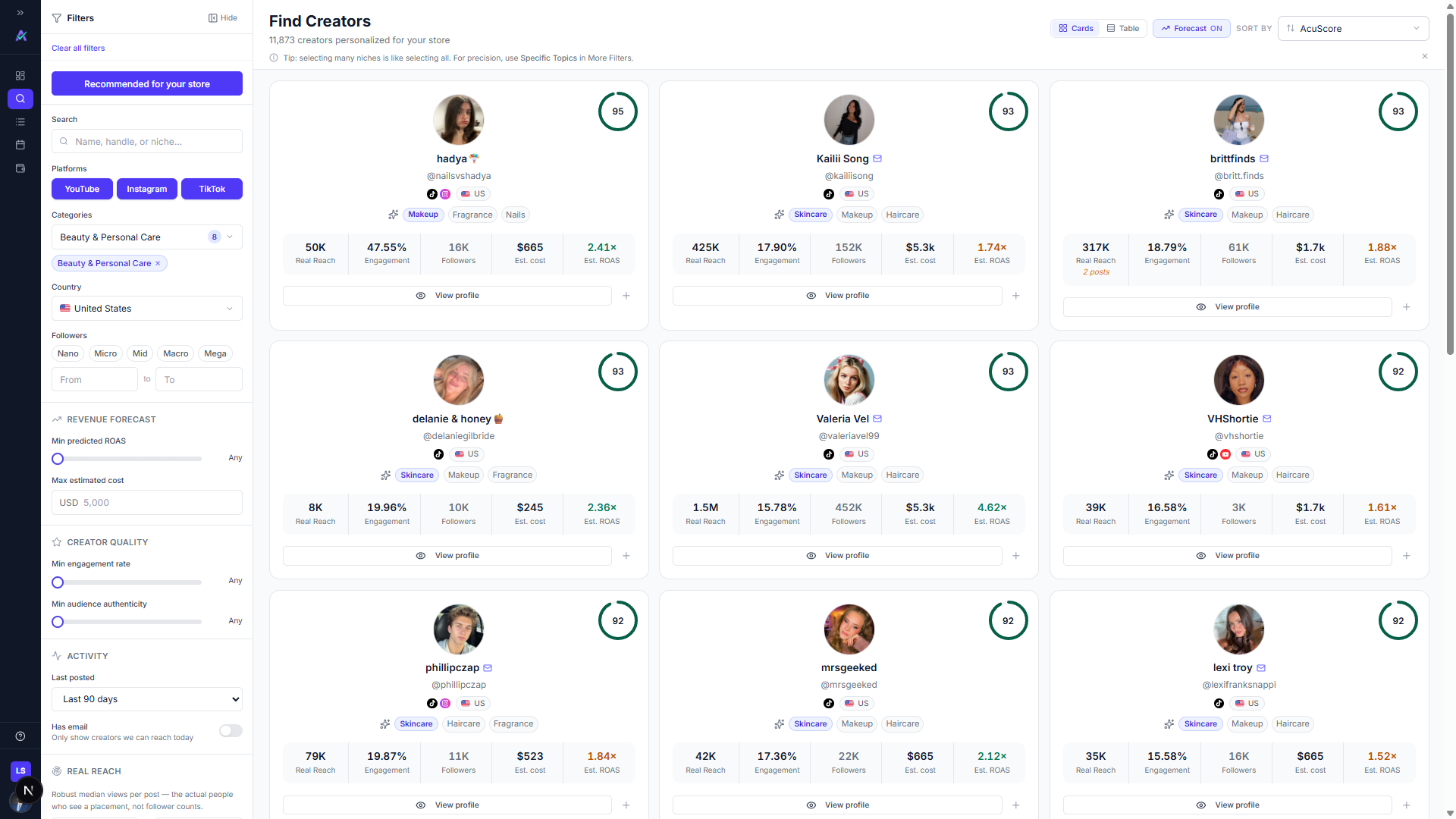
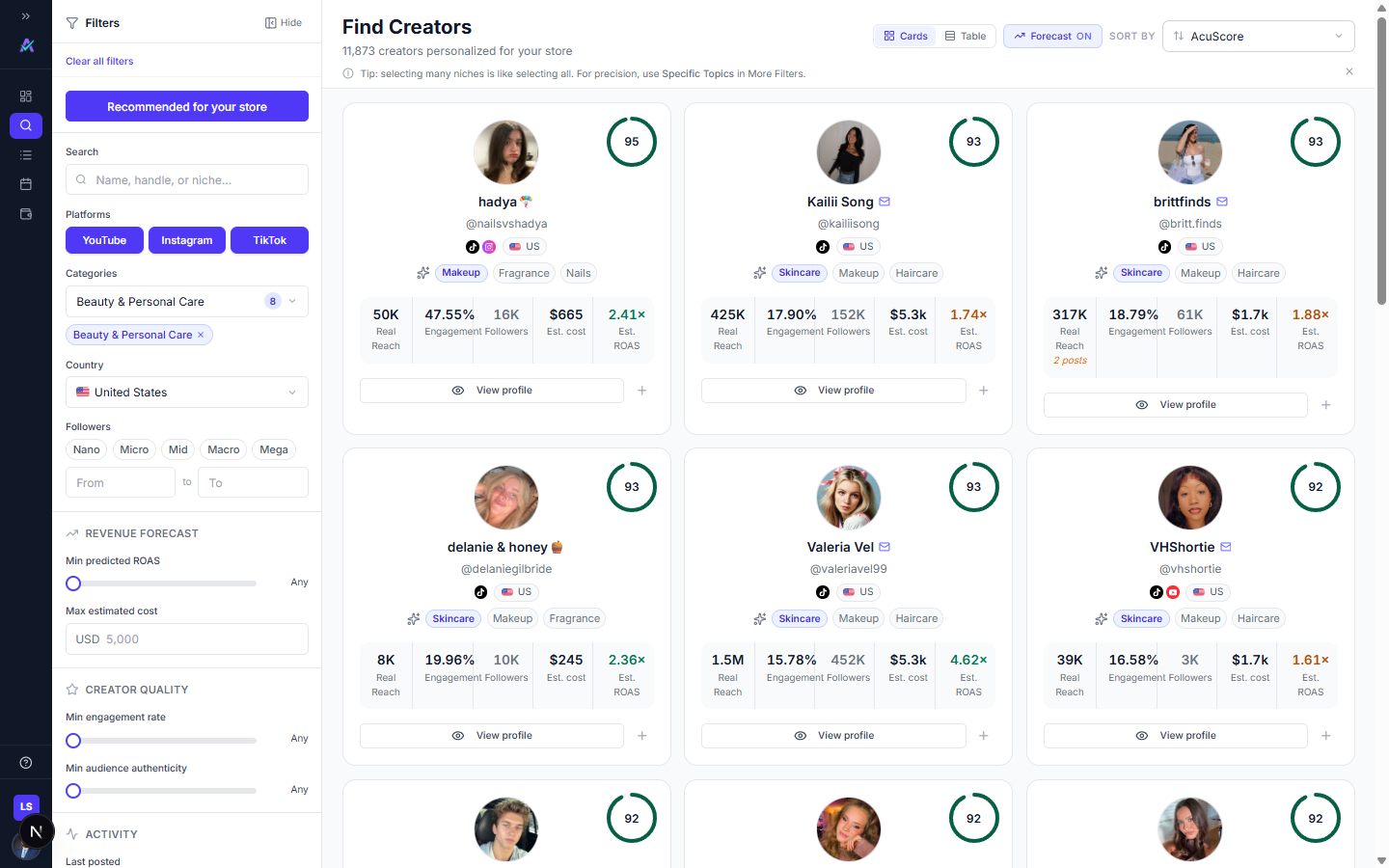
Every creator is ranked for this store by AcuScore — fit × quality × the revenue they'll drive — and every row carries its own profit forecast: real reach, estimated cost, estimated ROAS. Not follower vanity; the money math, on your store's real economics, across 1M+ creators we own outright.
Live product, June 2026 — real connected store (Luma Skin), real catalog.
How the forecast works — every number derives from the one above
From real views to a verdict. No black box.
It starts from the views that actually show up — robust median views, not follower counts — and walks to profit in five auditable steps, on your store's numbers.
46,400
median views (recent posts, robust)
→
418
clicks × 0.9% CTR
→
9
customers × your 2.1% conversion
→
$1,980
first-order sales × your $220 AOV
→
$2,870
12-mo gross profit × returning rate & margin
→
+$1,847
predicted profit after the $1,023 fee — before anything is signed
AOV, conversion and returning-customer rate pull from Shopify automatically — so the forecast runs on your real store economics, not category averages. It's the one number no competitor can put on screen.
And that fee isn't fixed — the forecast is your negotiating ceiling. Talk one deal down to fair value and Acurrate's paid for the year.
One platform, the whole job
The decision is the wedge. The lifecycle is the lock-in.
Discover
1M+ creators, ranked
Forecast
profit before you sign
Negotiate
the fee that hits target
Agreement
AI draft + e-sign
Plan
schedule the year
Pay
money moves
app.acurrate.com/discover
Step 1 / 6 · Discover
Find the ones that'll make money.
1M+ creators we own outright, ranked by AcuScore — fit × quality × the revenue they'll drive on your store. Not follower vanity: the money math, on your economics.
Next: click Forecast →
Discovery + contracts + payments — $500–2,000/mo across three stacked tools elsewhere. Acurrate is all of it, one login, $99 flat.
Wedge → rail
The subscription is the foothold. The money flowing through is the business.
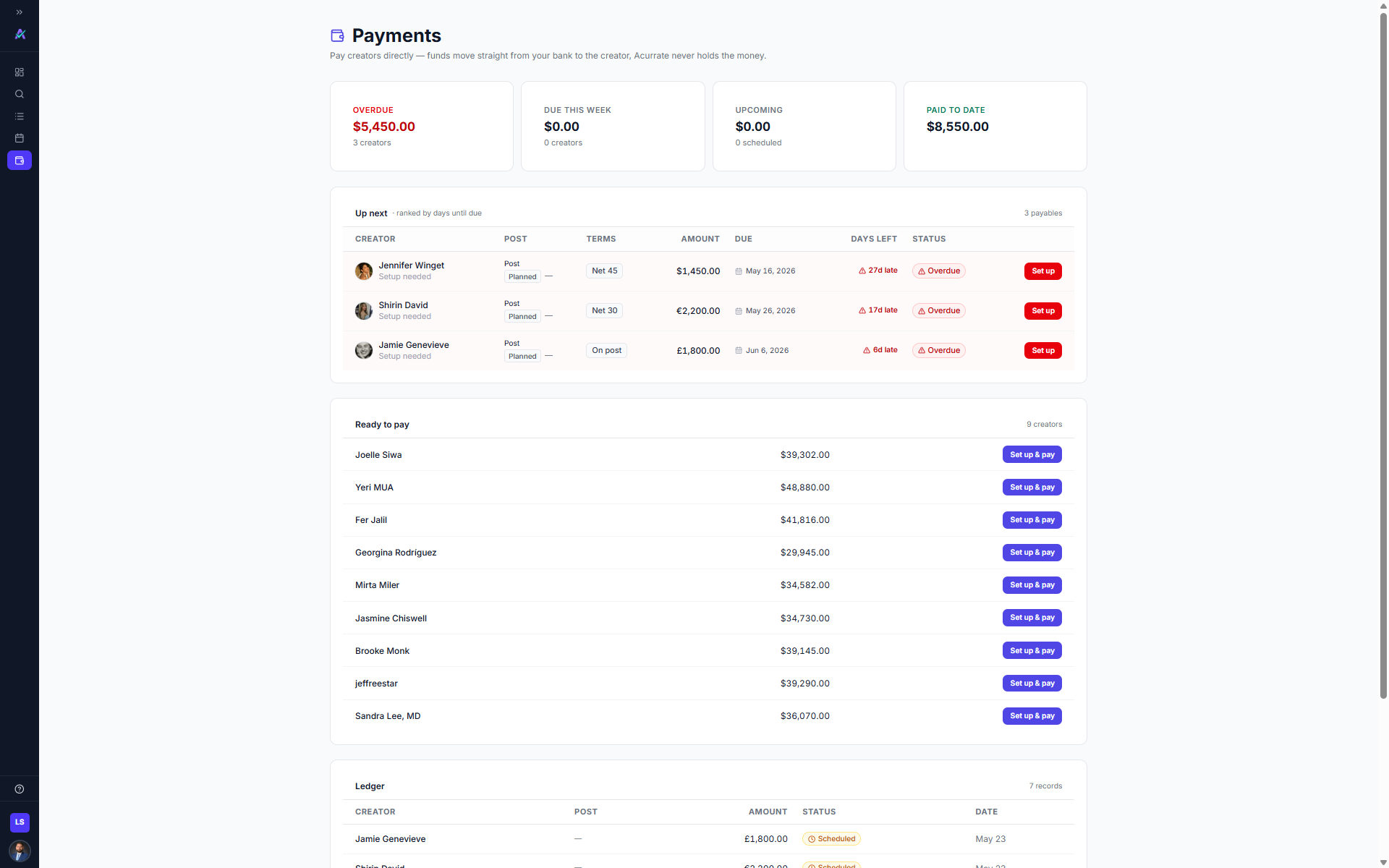
app.acurrate.com/payments
Once we sit at the decision, we own the payout. The Pay surface is built and live in-product — creator payments already run through it. The monetization switch — a ~0.75% net facilitation fee on every dollar — flips on in Year 2, once volume is proven. We never touch the float.
Three locks opened at once. You couldn't have built this 18 months ago.
Three things had to be true at the same time for this company to exist — and all three only became true in the last 18 months. That's the window we're raising into.
2020 → 2025
Spend hit critical mass
$9.7B → $33B. Creator marketing became a board-level budget line, not an experiment — so the ROI question became urgent.
May 2026
Shopify unlocked the data
Shopify opened Protected Customer Data — a brand's real AOV, conversion and margin now flow into the forecast in one click. That pipe didn't exist 18 months ago.
Now
AI collapsed the cost floor
Self-hosted scraping + distilled ML took the all-in cost of building a creator dataset to ~$0.003 a creator. A $99 flat price became viable where incumbents need $399+.
Shopify PCD L2 program · as-built data costs: ~$0.0029/creator blended ingest+enrich (self-hosted YT scrape via DataImpulse + TT/IG + distilled-ML/Gemini classify).
Why it lasts — structural, not a trend
Not a trend — a structural shift. The money has nowhere else to go.
Three independent forces are pushing budget into creators. None of them reverses — they compound.
01 · Attention & trust moved
Consumers discover and buy from creators they trust, not from interruptive ads. For a generation, the creator is the storefront and the review — and attention isn't coming back to banner ads.
~50%
of consumers rely on creator recommendations to decide what to buy
02 · Tracked ads are breaking
Privacy laws, cookie loss, ATT and ad blockers degrade paid targeting and inflate CAC. A creator's audience is the targeting — a gardening channel is gardeners, forever. No cookie or new law switches that off, so budget migrates — and privacy only ever tightens.
+40%
e-commerce CAC since 2023 · ATT alone cost Meta ~$10B/yr
03 · Now permanent infrastructure
Creator marketing crossed into board-level budgets, and the platforms are wiring commerce into the content — TikTok Shop, Instagram and YouTube checkout. Once it's a measured line item with native checkout, it doesn't leave.
74%
of brands are increasing creator budgets in 2026
Every one of these funnels more money into the one channel that still has no profit layer. That empty seat is the one we own.
Consumer-trust survey (creator recommendations) · Meta investor guidance, Feb 2022 (ATT ~$10B) · SimplicityDX / Ringly CAC benchmarks (+40% since 2023) · Aspire 2026 creator-budget survey · platform commerce: TikTok Shop / Instagram / YouTube Shopping. Figures to re-confirm before send.
Why we win — and keep winning
They can't follow us to $99. Their payroll won't let them.
Monthly burn — drawn to scale
GRIN · 200+ ppl$2.5M+/mo
HypeAuditor · ~100 ppl$1.2M+/mo
Modash · ~50 ppl$500–700K/mo
Acurrate · 1 founder + AI team$230/mo
true bar = 0.1px — drawn bigger so you can see it
~$18K, once
builds the entire 5M-creator dataset — the same data an incumbent runs hundreds of staff to maintain. ~$0.003 a creator, all-in.
$0 / year
data licensing — we own the catalog outright (~$450/mo to run); every new rival rents theirs from the incumbents, forever
$99 flat
one price, 2 seats included (+$9/extra) — vs Modash/GRIN per-seat at $399–1,000+. Pays for itself on the first deal you don't overpay. 14-day free trial, no card.
~2 hrs
per feature, AI-supervised build — vs their 10–30 engineer-hours
The $18K isn't the moat — anyone could spend it. The moat is owning the data instead of renting it, the Shopify-PCD forecast no incumbent can match at their price, and being first into the money layer. The cost structure is simply why they can't price-follow us to $99.
Headcount/burn: public team pages + loaded-cost estimates. Acurrate $230/mo = today's actual cash cost (pre-raise, founder unsalaried); the post-raise operating plan is in The Numbers. Modash entry price doubled to $399, July 2026.
The market — bottom-up, not hand-waved
Shopify is the wedge. The market is every brand running creators.
$33B / yrcreator spend → ~$100B by 2030
~$1.4BTAM today · software + payments → ~$4B by 2030
~$400MSAM · all e-commerce + agencies
$119MSAM · Shopify wedge
$3.1MSOM · base-case run-rate, Year 3
Land on the Shopify wedge; expand across the ~3×-larger all-platform pool.
Massive TAM, disciplined wedge
The forecast engine isn't Shopify-locked — it runs on any brand's economics. Shopify auto-fills them; everyone else connects another platform or types them in.
So the same product expands to every e-commerce platform, then every brand running creators — the market Modash and GRIN already proved is billions, where none of them can forecast profit.
We start on Shopify because we have the data + distribution edge there
Statista/Mordor creator-spend $33B (2025) → ~$80–115B by 2030 · TAM ≈ ~1M brands worldwide running creator budgets × $1,188/yr + ~$250M payments at 0.75% of channel GMV · expanded SAM ≈ ~300K all-platform ICP brands (Shopify ≈29% of serious e-commerce) · Shopify SAM: ICP ≥$50K/mo (~100K stores) · SOM: model base case. The whole ladder scales ~3× by 2030 as the channel triples ($33B→~$100B) — TAM ~$1.4B→~$4B. Forecasts stay bottoms-up (penetration-driven), independent of TAM.
De-risked, not a deck promise
It's all already built — before the round.
1M+
Owned creator dataset
enriched, ours, zero licensing cost
6 surfaces
Live platform
Discover→Forecast→Negotiate→Agreement→Plan→Pay
Pay rail
Stripe Connect payouts
built & live; fee layer switches on in Year 2
Shopify ✓
App Store + PCD Level 2
live & approved · the highest data tier
UK ®
Registered trademark
Acurrate Limited, a real entity
$50K in
Anchor secured
family office, round open
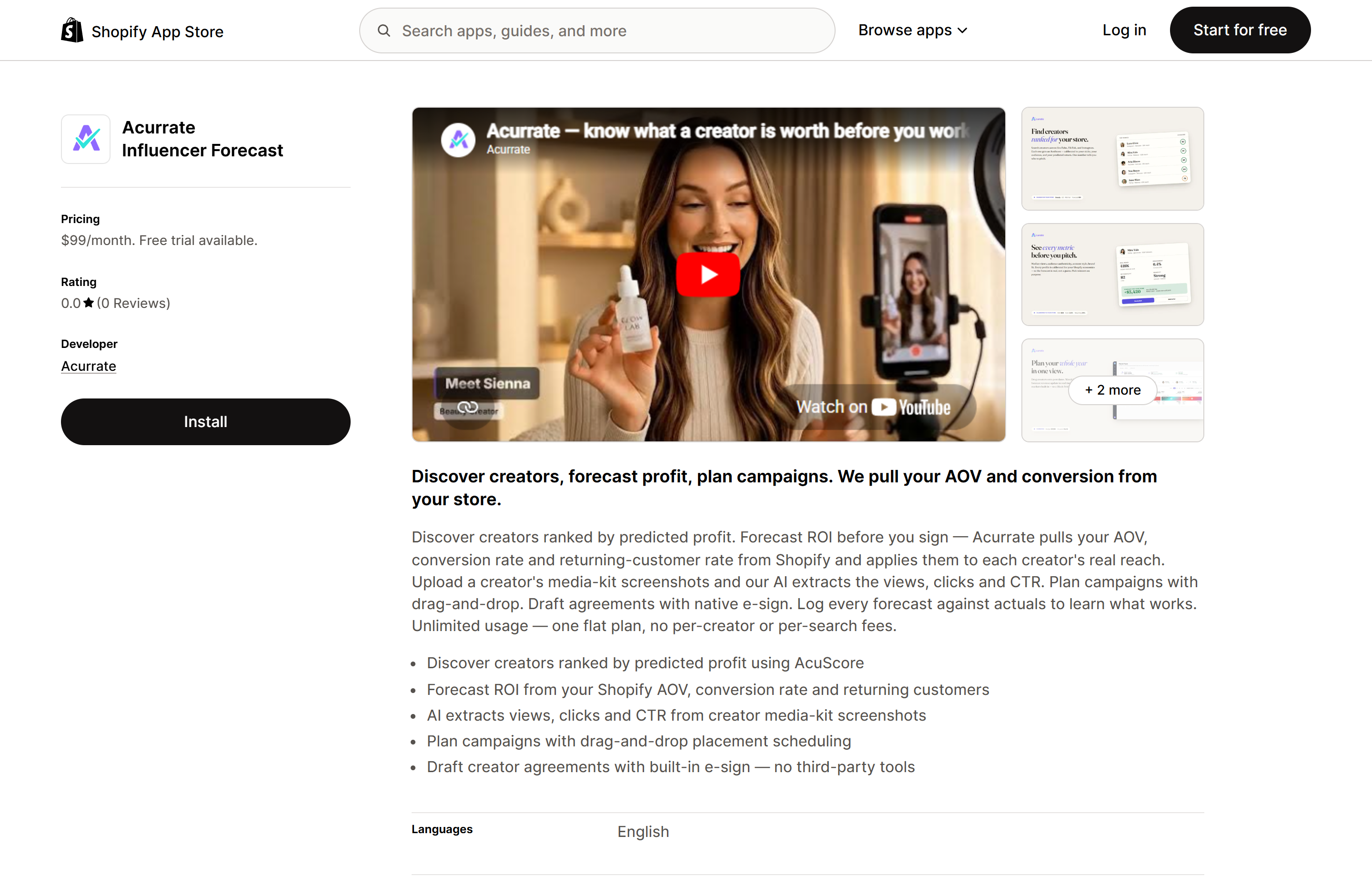
apps.shopify.com/acurrate-influencer-forecast
Shopify put us through a two-month review and strict data due-diligence before listing us — a platform with millions of merchants vetted us, and it's a gate every rival must clear too. See it live on the App Store →
The team — and the plan
A three-person team that ships like ten. The round funds demand.
People — who the round puts on
Nick — Founder & CEO
Product, founder-led sales, the raise. A below-market salary, after nine months unpaid.
Growth marketer — Month 1
First hire. Content, SEO, App Store, paid — the compounding demand channels. Not a sales AE: it's self-serve at $99.
Fractional engineer — Month 1
Contract, ~2 days/week: maintenance, ops, bug-fixing — and key-person cover. Steps to full-time once the base funds it.
Customer success — gated
Added at 15 paying customers. Never hired before there are customers to keep.
The AI operating system — how a tiny team ships like a big one
A directed AI engineering operation the founder architects and runs — specialised agents, each owning a lane:
Mikearchitecture / CTO agent
Davedata & database agent
Steve & Charlesfull-stack agents
The growth hire runs the same playbook — AI-amplified content, ASO and campaign production. AI agents, not employees — a three-person team with the output of ~10, at ~$230/mo of AI spend and zero key-person dilution.
Today, zero salaries — the founder's unpaid. Under $250K of the round funds this team for two years: the output of ~10 people, a fraction of a ten-person payroll. The product is built and shipped — this round funds distribution, not development.
The 5-year picture — the Shopify plan, then beyond it
Profitable in Year 2. Then it scales past Shopify.
$214K
Year 1Aug 26
$1.2M
Year 2breakeven
$2.5M
Year 3Shopify
$5.6M
Year 4+ expansion
$16.0M
Year 5illustrative
SubscriptionPaymentsEBITDA▦ Years 4–5 illustrative (beyond Shopify)
$3.1M
revenue run-rate, month 36
Jul-27
EBITDA-positive
95%
gross margin
2.4mo
CAC payback
10.0×
LTV : CAC
2,309
customers, month 36
$261K
cash trough — never near zero, in any scenario
24+ mo
survival runway at $0 revenue
Customers are an output of channel math — no hardcoded hockey stick. The full live model is in the data room; edit any assumption, it recalculates.
Acurrate model, June 2026 — Excel-verified, balance-sheet tied. Y1–3 = the bottoms-up Shopify plan (the raise stands on these). Y4–5 illustrative: other e-com platforms + global brands (the ~$400M all-platform SAM) + the payments rail inflecting to ~24% of revenue by Year 5.
Your return — stress-test it yourself
What a cheque today becomes. Bear to bull.
These compound off a deliberately low entry cap and a conservative base case — our Year-3 SOM is a fiftieth of the Shopify wedge alone. The point isn't the headline multiple; it's that even the Bear case clears the cap at every round — no down-rounds in any scenario.
Your investment
$
24.9×
illustrative return at a Year-5 exit (~2031) · $25,000 → $623K
Entry on a SAFE at the $5M post-money cap (20% discount = extra upside). Your stake rides every round; ownership dilutes, value compounds.
How this is calculated →
Illustrative scenarios, not a forecast or an offer of securities. Round valuations = the model's projected ARR (Year-4/5 illustrative) × labelled 2026 vertical-SaaS+fintech multiples, less stated dilution. Even the Bear case clears the entry cap at every round.
The ask
$500K · $5M post cap · 20% discount.
$50,000 secured · 10% — family-office anchor
$300K = fully operational · $500K = full speed
Instrument: YC SAFE (US) / ASA (UK, SEIS-eligible) · MFN · ~10% dilution at cap. Why the cap is fair: you're not funding a deck — the dataset, the Shopify approvals and the live payout rail are already built, so the slow, risky parts are done. De-risked well beyond a typical pre-seed, priced at a pre-seed cap. Pre-revenue by design: the build is finished and shipped — this round funds go-to-market, not development. Runway: 24+ months → profitable → next round from a position of power, not need.
$500K
use of funds
Team & salaries · 46%
Sales & marketing (growth, content, ads) · 42%
Infra + data (the cheap moat) · 6%
Legal + reserves · 6%
Let's build the platform every brand runs creators on.